
Sandwich Panel Construction: A Complete Guide to Modern Insulated Building Solutions
Sandwich panel construction is becoming increasingly popular in Bangladesh for industrial buildings, warehouses, cold storage facilities, poultry farms, food processing plants, pharmaceutical facilities, cleanrooms, offices, and other temperature-controlled spaces. Compared with conventional brick-and-cement construction, sandwich panels provide faster installation, improved thermal insulation, reduced structural load, and better control over indoor temperatures.
At SA EPS Insulation & Packaging, we provide complete sandwich panel construction solutions using high-quality EPS sandwich panels, PU sandwich panels, and Rockwool sandwich panels. Our solutions are designed to meet the insulation, durability, fire-resistance, and functional requirements of different commercial and industrial projects across Bangladesh.
Whether you are constructing a factory, warehouse, cold room, poultry farm, food processing area, or prefabricated building, choosing the right sandwich panel and construction method can significantly affect the building’s energy efficiency, operating cost, and long-term performance.
What Is Sandwich Panel Construction?
Sandwich panel construction is a modern building system where insulated panels are used to form walls, roofs, partitions, ceilings, and temperature-controlled enclosures.
A typical sandwich panel consists of three primary layers:
- An external metal sheet
- An insulated core
- An internal metal sheet
The core provides thermal and, depending on the material, acoustic and fire-resistance properties, while the outer metal sheets provide structural protection and surface durability.
Depending on project requirements, the insulation core can be made from EPS (Expanded Polystyrene), PU (Polyurethane), or Rockwool.
The panels are manufactured in controlled dimensions and installed by joining individual panels through specially designed profiles and interlocking systems. This makes sandwich panel construction considerably faster than traditional masonry construction.
How Does Sandwich Panel Construction Work?
The sandwich panel construction process generally begins with project assessment and design. The required panel type, thickness, density, steel sheet specification, dimensions, and installation method are determined based on the intended application.
The basic process includes:
1. Project Assessment and Planning
Before installation begins, the building dimensions and application are evaluated. Important factors include:
- Building size
- Required insulation level
- Indoor temperature requirements
- Wall and roof applications
- Environmental conditions
- Fire-resistance requirements
- Structural requirements
- Door and window locations
- Electrical and mechanical services
This assessment helps determine the appropriate sandwich panel system.
2. Selection of Sandwich Panel
Different applications require different insulation materials.
EPS Sandwich Panels are suitable for many general insulation applications where cost-effectiveness and thermal insulation are important.
PU Sandwich Panels offer higher thermal insulation performance and are particularly useful for cold rooms, cold storage, food processing facilities, and temperature-controlled environments.
Rockwool Sandwich Panels are preferred where fire resistance and thermal insulation are major considerations.
At SA EPS Insulation & Packaging, we provide EPS, PU, and Rockwool sandwich panel solutions based on project requirements.
3. Supporting Structure Preparation
Sandwich panels are typically installed over an appropriate structural framework. Depending on the building design, the supporting structure can consist of steel sections, purlins, columns, or other suitable framing systems.
The framework must be properly aligned before panel installation. Accurate alignment is important because it ensures that the panels fit correctly and that joints remain properly sealed.
4. Wall Panel Installation
Wall panels are positioned against the supporting structure and fixed using appropriate fasteners and accessories.
The panels are joined together through their designed joint system. Proper joining minimizes gaps between panels and helps maintain thermal insulation performance.
For partition walls, sandwich panels can also be installed inside existing buildings to create insulated rooms, production areas, storage spaces, offices, or controlled environments.
5. Roof Panel Installation
For roof applications, sandwich roof panels are installed over the structural framework according to the building design.
Proper panel alignment, fixing, overlapping, flashing, and sealing are essential for protecting the building against rainwater penetration and maintaining long-term performance.
6. Joint Sealing and Finishing
One of the most important parts of sandwich panel construction is joint treatment.
Even a high-quality insulated panel can lose performance if joints are poorly installed. Appropriate sealants, flashing, trims, corners, and other accessories are used to create a properly finished enclosure.
For temperature-controlled applications, careful attention to panel joints and openings is particularly important because uncontrolled air leakage can reduce energy efficiency.
Types of Sandwich Panels Used in Construction
The insulation core is one of the most important factors when selecting a sandwich panel construction system.
EPS Sandwich Panel Construction
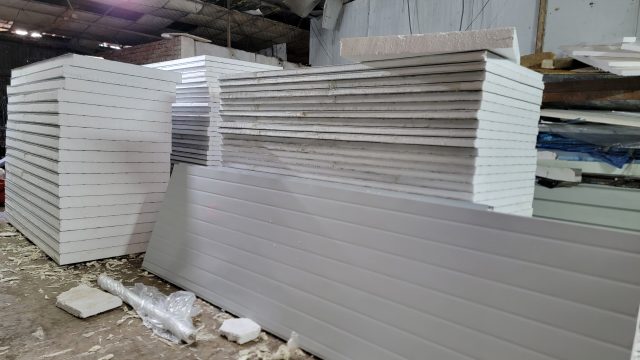
EPS, or Expanded Polystyrene, is a lightweight insulation material commonly used in sandwich panel construction.
EPS sandwich panels can be used for:
- Industrial sheds
- Warehouses
- Poultry farms
- Site offices
- Temporary buildings
- Factory partitions
- Commercial spaces
- Storage areas
- Agricultural buildings
- Prefabricated structures
EPS panels offer a practical combination of thermal insulation, lightweight construction, easy installation, and cost efficiency.
SA EPS Insulation & Packaging manufactures and supplies EPS Sandwich Panels for different wall, roof, and partition applications across Bangladesh.
PU Sandwich Panel Construction
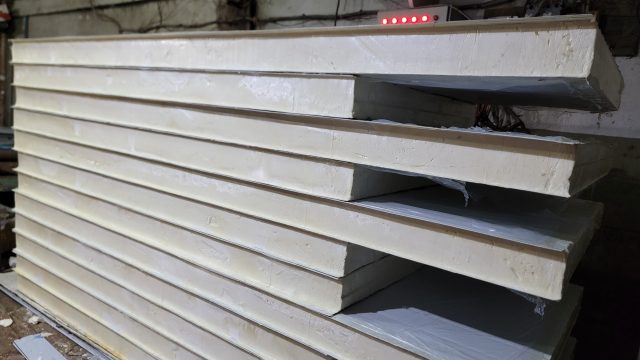
PU, or Polyurethane, sandwich panels provide excellent thermal insulation due to their low thermal conductivity.
They are particularly suitable for applications where temperature control is important, including:
- Cold storage
- Cold rooms
- Food processing facilities
- Pharmaceutical facilities
- Temperature-controlled warehouses
- Bakery rooms
- Mushroom cultivation rooms
- Chiller rooms
- Refrigerated spaces
PU sandwich panels can help reduce heat transfer through walls and roofs, allowing cooling systems to operate more efficiently when the overall building envelope is properly designed and installed.
For projects requiring reliable temperature control, PU sandwich panel construction is an effective solution.
Rockwool Sandwich Panel Construction
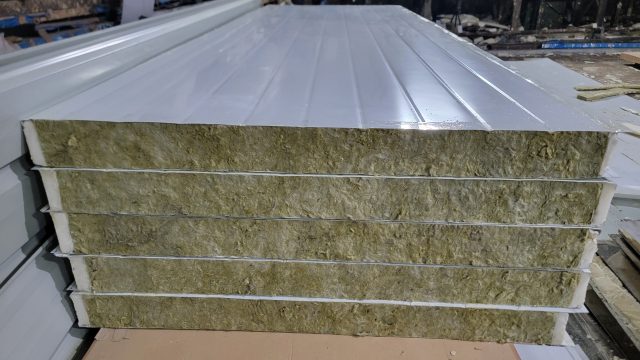
Rockwool sandwich panels use mineral wool insulation as their core material.
They are often selected for projects where fire performance is a major consideration alongside thermal and acoustic insulation.
Typical applications include:
- Industrial buildings
- Factories
- Warehouses
- Generator rooms
- Commercial buildings
- Industrial partitions
- Fire-sensitive areas
- Manufacturing facilities
The appropriate Rockwool panel specification should be selected according to the project’s fire-resistance and construction requirements.
Major Applications of Sandwich Panel Construction
Sandwich panels can be used in a wide range of commercial, industrial, agricultural, and temperature-controlled projects.
Industrial Sheds and Warehouses
Sandwich panels are widely used for warehouse walls and roofs because they provide an insulated building envelope without the time and material requirements of traditional masonry construction.
They can help protect stored goods from external heat and create a more comfortable internal environment.
Cold Storage and Cold Rooms
Temperature-controlled facilities require effective insulation to reduce heat transfer.
PU sandwich panels are particularly suitable for cold storage and cold room construction because of their strong thermal insulation performance.
Panel thickness and insulation specifications should be selected based on the required operating temperature and refrigeration system.
Poultry Farms
Maintaining appropriate indoor environmental conditions is important for poultry production.
Insulated sandwich panels can be used for poultry farm walls and roofs to reduce heat transfer from the outside environment and support more consistent indoor conditions.
EPS sandwich panels are commonly used in poultry control sheds where practical thermal insulation and cost efficiency are required.
Food Processing Facilities
Food processing environments often require hygienic, easy-to-maintain surfaces and controlled indoor conditions.
Sandwich panels can be used for production areas, processing rooms, storage areas, partitions, and temperature-controlled spaces.
Pharmaceutical Facilities
Pharmaceutical production and storage environments can require controlled temperature, cleanliness, and suitable room separation.
Depending on the project’s technical requirements, insulated sandwich panels can be used for internal partitions, controlled rooms, storage areas, and other specialized spaces.
Cleanrooms and Controlled Environments
Sandwich panel systems can provide smooth, insulated surfaces for controlled environments.
With appropriate panel selection, joint treatment, accessories, and installation, they can be used for cleanrooms, laboratories, food production areas, and other controlled spaces.
Factory and Office Partitions
Sandwich panels aren’t limited to complete buildings. They can also be used to create partitions within existing industrial and commercial spaces.
For example, a large factory can be divided into:
- Production rooms
- Storage rooms
- Office areas
- Temperature-controlled spaces
- Worker facilities
- Equipment rooms
This makes sandwich panels useful for both new construction and renovation projects.
Benefits of Sandwich Panel Construction
Faster Installation
One of the main advantages of sandwich panel construction is installation speed.
Because panels are manufactured in advance and installed using a systematic fixing process, construction can be completed much faster than conventional brick walls in many applications.
Thermal Insulation
The insulated core reduces heat transfer between the interior and exterior.
The actual thermal performance depends on factors such as:
- Core material
- Panel thickness
- Core density
- Joint quality
- Installation quality
- External temperature
- Building design
Lightweight Construction
Sandwich panels are comparatively lightweight compared with traditional masonry wall systems.
Lower wall weight can simplify handling and installation and may reduce the overall structural requirements depending on the project design.
Reduced Construction Time
A faster installation process can help businesses bring factories, warehouses, storage facilities, and commercial spaces into operation sooner.
For industrial projects where downtime affects productivity, this can be a major advantage.
Clean and Professional Appearance
Color-coated steel sheets provide sandwich panels with a clean, uniform appearance.
Panels are available in different specifications and colors to suit different building requirements.
Easy Maintenance
Properly installed sandwich panels can provide durable surfaces that are relatively easy to clean and maintain.
This is particularly useful in industrial, food processing, pharmaceutical, and controlled-environment facilities.
Why Panel Thickness Matters
Panel thickness should not be selected simply based on price.
A thicker panel generally provides greater insulation potential, but the correct thickness depends on the application’s thermal and structural requirements.
For example, a general warehouse may require a different panel specification from a cold storage facility.
Factors that should be considered include:
- Required indoor temperature
- Outdoor climate
- Building use
- Cooling load
- Insulation material
- Panel density
- Panel thickness
- Joint design
- Door and opening configuration
At SA EPS Insulation & Packaging, we can help customers select an appropriate panel specification based on their project requirements.
Sandwich Panel Construction vs. Traditional Construction
Traditional brick-and-cement construction can require significant amounts of labor, materials, and construction time.
Sandwich panel construction offers a different approach by combining insulation and enclosure into a prefabricated panel.
| Feature | Sandwich Panel Construction | Traditional Construction |
|---|---|---|
| Installation speed | Fast | Generally slower |
| Thermal insulation | Built into the panel | Requires separate insulation |
| Construction weight | Relatively lightweight | Generally heavier |
| Installation | Systematic panel installation | Multiple construction stages |
| Surface finish | Factory-coated metal sheet | Separate finishing required |
| Temperature-controlled spaces | Highly suitable | Requires additional insulation |
| Modification | Relatively convenient | Usually more disruptive |
The best choice depends on the building’s design, budget, operating conditions, and technical requirements.
Why Choose SA EPS Insulation & Packaging for Sandwich Panel Construction?
SA EPS Insulation & Packaging is a Bangladesh-based manufacturer and supplier of insulation and packaging solutions, established in 2017.
We provide sandwich panel solutions for a wide range of commercial, industrial, agricultural, and temperature-controlled applications.
Our sandwich panel solutions include:
- EPS Sandwich Panels
- PU Sandwich Panels
- Rockwool Sandwich Panels
- EPS Roof Panels
- PU Roof Panels
- Rockwool Roof Panels
- Wall and partition panel solutions
- Cold room and cold storage panel solutions
Our team can support projects from panel selection and manufacturing through to installation requirements, depending on the project scope.
We understand that every project has different requirements. Therefore, panel thickness, insulation material, dimensions, steel sheet specifications, and other technical details can be considered according to the specific application.
Our solutions are available for projects throughout Bangladesh.
Get the Right Sandwich Panel Construction Solution for Your Project
Selecting the right sandwich panel is only one part of a successful insulated building project. Proper design, panel thickness, structural support, fixing, joint sealing, flashing, and installation quality all contribute to the final performance of the building.
Whether you need an insulated warehouse, poultry farm, industrial shed, cold room, food processing facility, pharmaceutical area, cleanroom, factory partition, or other temperature-controlled structure, the right sandwich panel construction system can provide a practical alternative to conventional construction.
SA EPS Insulation & Packaging provides EPS, PU, and Rockwool sandwich panel solutions across Bangladesh, helping businesses build insulated and functional spaces according to their project requirements.
Contact SA EPS Insulation & Packaging today to discuss your sandwich panel construction project and determine the right panel solution for your application.